Mini Split Installation in Rolla, ND
A new system here will heat from September through June and cool from July through July every year. Tell us about the house, and a licensed contractor who covers Rolette County will get in touch.
Tell us about the job
It takes about a minute.
Rolette County asks a mini-split to heat, not just cool
Winter nights here average 0°F from December through February, and homes need heat from September through June. That is 10 months of heating against one month of cooling, so the heating side of the unit is what matters most in this county.
Cold this deep means the heat pump has to keep pulling warmth out of outside air that barely has any. Any mini-split installed new here has to meet the federal minimum of 7.5 HSPF2 for heating and 14.3 SEER2 for cooling, but in a place this cold, how well it performs well below freezing matters more than the rating on the label.
- 10 months
- September through June, your system heats
- 1 months
- July through July, it cools
- 0°F
- the average winter night it heats against
- 76°F
- the average summer afternoon it cools against
NOAA nClimDiv, 1991–2020 normals
North Dakota requires HVAC contractors to hold a state license.
North Dakota's license is held by the contractor, not issued job by job. It is the business that is on record with the Secretary of State, not any one installation. Work under $4,000 does not need a licensed contractor at all, so whether that record applies depends on how the job is priced.
Where the license does apply, it is the license that stands behind the work, since North Dakota is one of the states that tests and records the contractor directly. Most cities and counties also require a permit for a mini-split installation, with an inspection once the work is done, and that inspection is what catches a bad connection or a wiring mistake before it becomes a problem.
Sources: North Dakota Legislative Branch · North Dakota Secretary of State
- Is a mini split worth it?
- For most homes here, yes, since heat is needed from September through June and a mini split handles both heating and cooling from one system. Cold-climate mini splits are built to keep producing heat well below zero, which matters on nights that average 0°F here in the depths of winter. They also skip the ductwork, so you are not losing heat through runs that pass through unheated spaces. Whether it makes sense for your house depends on how it is laid out now and what you are heating with, so a contractor should walk through that with you.
- How many rooms can a mini split cover?
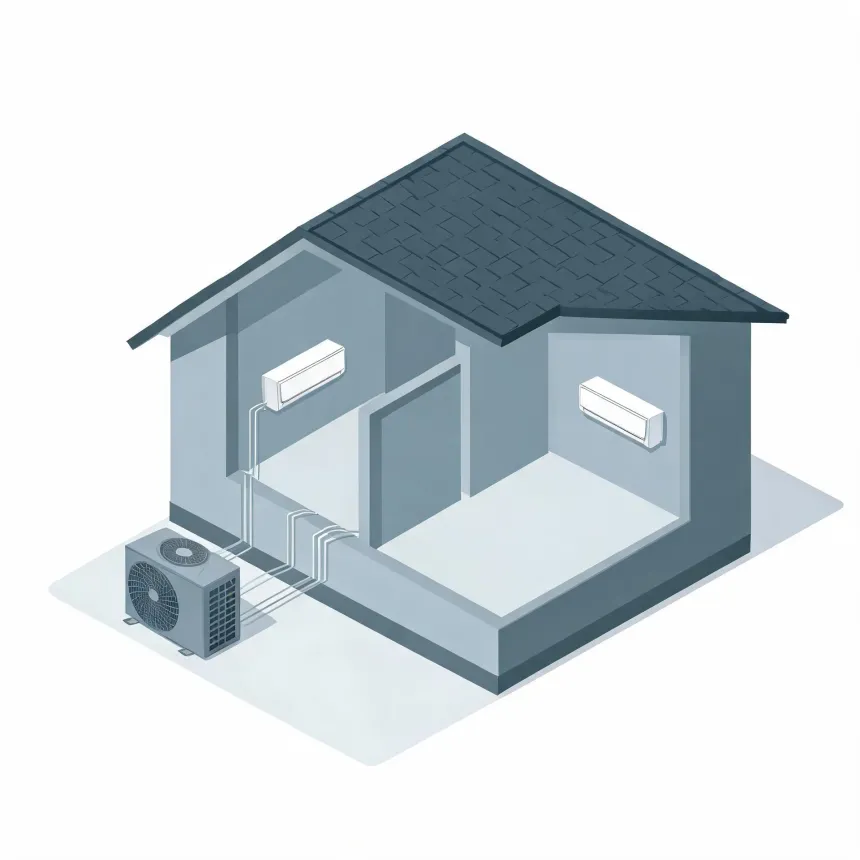
- A single outdoor unit can run several indoor heads at once, so a mini split can cover more than one room. Each indoor head is sized to the room it serves, so a contractor works out room by room how much heat or cooling each one needs before deciding how many heads and how large an outdoor unit the house calls for. Get that sizing wrong and you end up with rooms that never quite reach temperature or a system that cycles on and off too fast. That is a load calculation, and it is worth having done for your house specifically rather than guessed at.
- Can a mini split heat a whole house?
- Yes, a mini split can heat a whole house, with one indoor head placed in each room or zone that needs heat. Cold-climate models are designed to keep delivering heat even at very low outdoor temperatures, which is the main thing to check for a place where winter nights average 0°F from December through February. What decides whether it will actually keep the whole house warm is correct sizing for every room and for the outdoor unit itself, so that is where a contractor's load calculation earns its keep.