Mini Split Installation in Wahpeton, ND
A new system here will heat from September through May and cool from June through August every year. Tell us about the house, and a licensed contractor who covers Richland County will get in touch.
Tell us about the job
It takes about a minute.
A mini-split here has to work all year
Wahpeton needs heat or cooling every month of the year. Nine of those months are heat, with winter nights averaging 5°F from December through February. A mini-split installed here has to hold its output on those cold nights, not just on the milder ones at the edges of the season.
Summer only runs three months, June through August, with afternoons averaging around 80°F, so the cooling side has less to prove. Any new unit still has to meet the federal minimum for a split-system heat pump, 14.3 SEER2 for cooling and 7.5 HSPF2 for heating. That's the floor, not a feature, so it's worth asking what a contractor is installing above it for a season this long and this cold.
- 9 months
- September through May, your system heats
- 3 months
- June through August, it cools
- 5°F
- the average winter night it heats against
- 80°F
- the average summer afternoon it cools against
NOAA nClimDiv, 1991–2020 normals
North Dakota requires HVAC contractors to hold a state license.
North Dakota licenses HVAC contractors through the Secretary of State, and that license covers the contractor rather than each job they do. If your mini-split installation runs under $4,000, the state does not require the contractor to be licensed at all.
Most cities and counties require a permit for a mini-split installation, with an inspection once the work is finished, and that permit is the local building office's own check that the job was done right.
Sources: North Dakota Legislative Branch · North Dakota Secretary of State
- Is a mini split worth it?
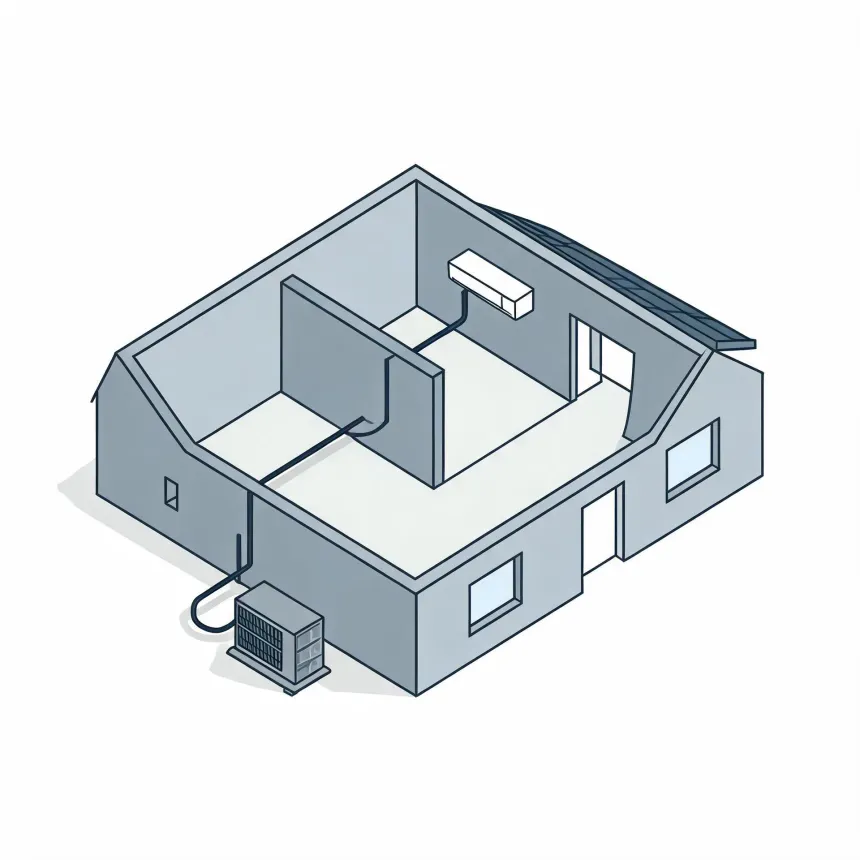
- For most homes here, yes, because a mini split handles both heat and cooling with one system. Winters here run cold, down to 5°F on average overnight, so the unit needs to be rated to perform at those temperatures. Summers are milder by comparison, averaging around 80°F, so the cooling side of the job is the easier part. A contractor can tell you whether your home's layout suits one outdoor unit with multiple indoor heads or something else.
- How many rooms can a mini split cover?
- A single outdoor unit can run several indoor heads, with the exact number depending on the system. Each indoor head is sized to the room it serves, so covering more rooms means matching the right output to each one, not just adding heads until the count works out. A contractor sizes this from the house itself, room by room, before recommending how many heads and what output each needs.
- Can a mini split heat a whole house?
- It can, if it's sized and placed for that from the start. With winter lows here averaging 5°F, the system has to be rated for cold-climate performance, not just standard heat pump output, or it will struggle on the coldest nights. Whole-house coverage usually means multiple indoor heads run off one or more outdoor units, placed so heat reaches every room. A contractor can work out whether your house's layout supports that or whether some rooms need a different approach.