



How often to clean air ducts in North Dakota

A local pro who cleans ducts gets in touch with you.

Get matched

Every three to five years is the general rule, but most homes here do fine sticking closer to five unless something's telling you otherwise. With gas heat running the system hard from October through March, dust and dander get pulled through the same ducts all winter, so a dirty system shows up as more buildup on registers and a furnace filter that clogs faster than it should. If anyone in the house has allergies, or you just had work done that kicked up a lot of dust, move the timeline up. Skip the fixed schedule if you've noticed must smell when the furnace kicks on, visible dust blowing out of vents, or rooms that never seem to heat evenly even with a new filter in. Those are signs the ducts need attention now, not on a five-year clock.

Unfinished basement interior with exposed wooden floor joists, galvanized rectangular and round sheet-metal ducts, a gray furnace unit at left, and a large blank light-colored wall at right.

What the furnace pulls through

Your furnace cycles the same air through the ducts all winter, so whatever settles in there gets stirred up and pushed back into the rooms every time it runs. A filter catches a lot of it, but it can't catch what's already sitting in the duct runs themselves. That's what a cleaning actually removes, not what's floating in the room air that day.

Galvanized sheet metal ductwork with elbows and a vent grille running beneath an exposed wood joist and OSB ceiling, next to a blank white wall.

What tells you it's time

Dust that shows up again within a day or two of cleaning a room, or a musty smell when the furnace first kicks on, points to buildup inside the ducts rather than anything in the house itself. If nobody in the house has allergies and the registers look clean when you check them, five years is a reasonable stretch. If something's off, don't wait on the schedule.

Clean Now or Wait

Clean the ducts

  • A contractor can run a camera through the ducts first and show you what's actually built up before doing any work.
  • Dust and pet dander that settle in the ducts get pulled loose and cleared out instead of cycling through the house all winter.
  • If anyone in the house deals with allergies, clearing out what's collected in there can make a noticeable difference.
  • A duct system that's never been cleaned since the house was built is a reasonable reason to move ahead now rather than wait.
  • Cleaning doesn't fix a leaky duct or a bad seal, so a dirty-looking return isn't always a dust problem alone.

Hold off

  • If it's been under three years since the last cleaning, there's usually not enough built up yet to matter.
  • A clean filter changed on schedule already stops most of what would otherwise settle inside the ducts.
  • Cleaning costs money and time on the schedule, and doing it early just repeats a job that's not due yet.
  • If nobody in the house has allergies or breathing trouble, there's less reason to move up the timeline.
  • Waiting the full three to five years is fine as long as the system hasn't been doing anything unusual.
Empty basement with bare concrete walls and floor, a small window at left, and exposed wood joists with galvanized sheet metal ductwork and pipes overhead.

Ducts doing their job

This is what clean ductwork looks like: metal runs and flex pipe carrying air without anything built up inside them. Gas heat can run from October through March without packing the ducts with dust, since there's nothing sitting in there to stir loose.


Dusty sheet-metal HVAC ducts with a rectangular vent register run beneath wooden floor joists above an empty concrete-walled basement.

Ducts that need attention

This is the buildup a contractor finds when they finally look. Years of dust and grime coat the inside of the duct, and every time the furnace kicks on, some of it gets pushed back into the rooms you're sitting in.

Is the dust in your house coming back faster than it should?

You dust the shelves and a week later they look the same again. The vents might have gray buildup around the edges, or the air coming out smells faintly musty when the furnace first kicks on in October. Someone in the house might be sneezing more at home than anywhere else, or you notice it most right when the heat has been running a while. None of that means the ducts are the only cause, but it's often where it starts, since whatever settled in there over the summer gets pushed through every room once gas heat takes over for the winter. Left alone, it's more for the furnace to push through and more landing back on your furniture and your floors.

A smiling bearded man in a dark crewneck sweater sits at a dinner table with a lit candle, glasses of wine and water, and plates of food in the foreground, with a lamp, framed art and a potted plant behind him.
A woman with dark hair in a bun reclines on a gray sofa with her eyes closed and a slight smile, wrapped in a cream knit sweater and blanket, with an open book resting in the foreground and a lit lamp in the dim room behind.
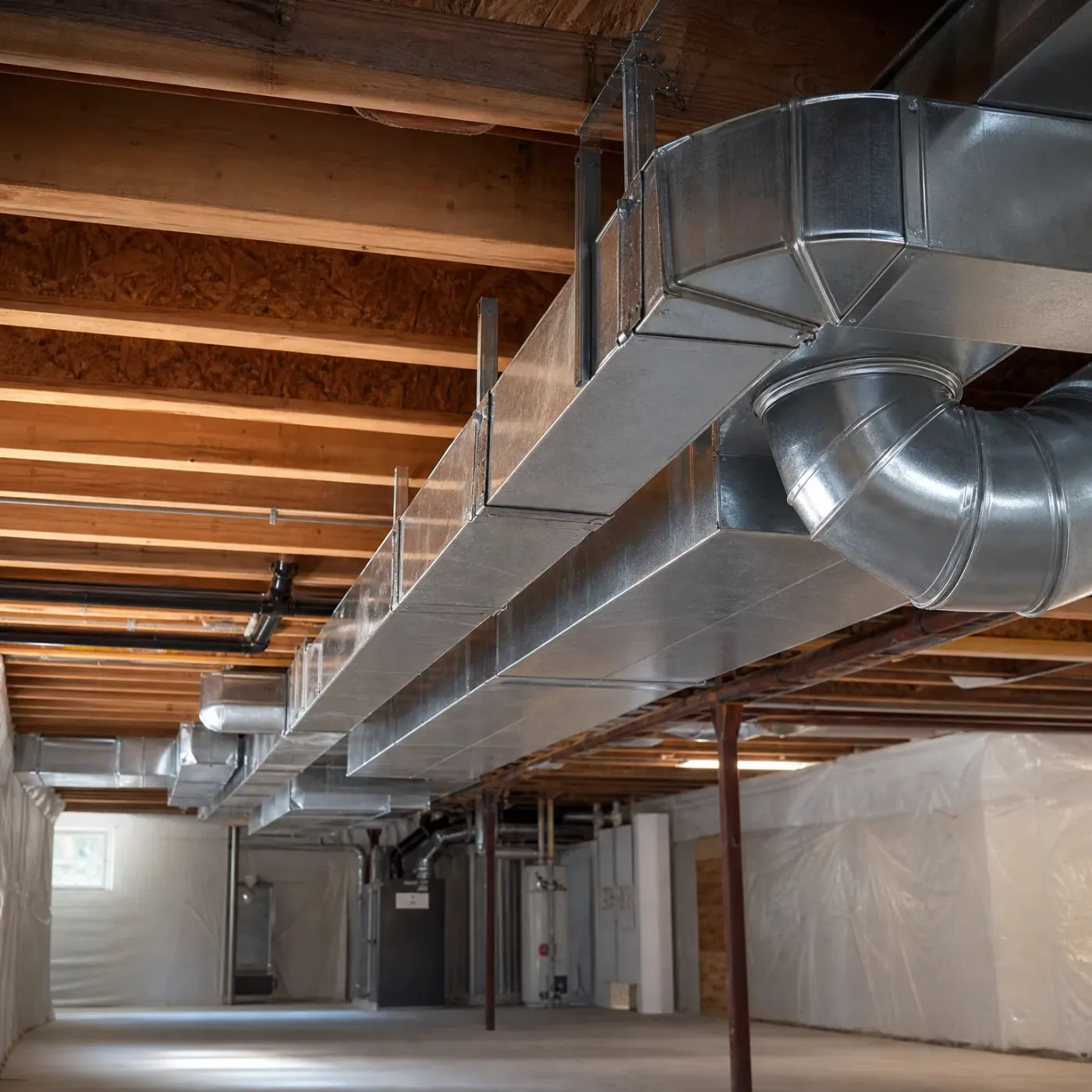
Unfinished basement with galvanized sheet-metal trunk ductwork and round branch ducts suspended beneath wood floor joists, with support posts, plastic sheeting on the walls, and a furnace and water heater along the far wall.

A local pro for your ductwork cleaning

Skip calling around for someone who cleans ducts.

Your duct cleaning request goes to a local pro who does this work.

Skip the search

Sending the form costs nothing.

A basement with a gray furnace on a concrete pad connected to large sheet-metal ducts running along an exposed wood joist ceiling, with PVC pipes and plastic sheeting on the walls.
Ductwork like this moves air the way it should, with nothing lining the metal to slow it down or feed back into the rooms.
Galvanized sheet metal HVAC ductwork with a vent grille running along a wooden joist ceiling above a bare concrete wall.
Once duct runs look like this, caked along the inside, the furnace is pushing that buildup into the house every time it cycles on.

Warm air leaves your furnace through the supply ducts and reaches every room, then gets pulled back through the return ducts to be filtered and heated again. That return side is where most of the dust sits, since it's the path air takes before the filter ever touches it. A contractor works through each run with a brush or whip, knocking loose whatever has built up on the walls of the duct, then pulls it out with a vacuum unit connected to the trunk line. The vacuum keeps the whole system under negative pressure while this happens, so what gets knocked loose goes out rather than further into the house. If you've got flex duct anywhere, expect more buildup there than in the metal runs. The ridges inside flex duct give dust something to grab onto in a way smooth metal doesn't. Check the registers themselves too. The first few feet behind each one tends to collect the fastest, since that's where room air and furnace air mix every time the system cycles.

How a duct cleaning actually works

  • Supply ducts carry warm air from the furnace to each room, while return ducts pull air back to be filtered and reheated.
  • A contractor cleaning the system runs a brush or whip through each run to knock debris loose before a vacuum unit pulls it out through the trunk line.
  • The return side usually holds more dust than the supply side, since that's the path air takes before it ever reaches the filter.
  • Flex duct holds onto dust more than smooth metal duct does, because the ridged interior gives debris more surface to catch on.
  • Registers and the first few feet of duct behind them build up fastest, since that's where room air and furnace air mix every cycle.
  • A whole-house vacuum unit keeps the system under negative pressure during cleaning, so loosened dust gets pulled out instead of pushed further into the ducts.
An unfinished basement with bare concrete walls and floor, showing exposed wooden floor joists, pipes, wiring, and metal HVAC ducts with a vent grille overhead.
Before you get your ductwork cleaning
Unfinished basement with galvanized sheet-metal rectangular and round ductwork running along a wood-joist ceiling, two steel support columns, a small window, and a furnace unit against the far right wall.
After you get your ductwork cleaning

Power costs 11.82 cents per kilowatt-hour statewide

At 11.82 cents a kilowatt-hour, running the blower longer than it needs to doesn't hit your bill hard, so there's no reason to skip a cleaning to save on power. The cost that matters here is the gas furnace pushing dusty air through the house all winter, not what the fan costs to run.

EIA-861 2025 statewide residential average

Unfinished basement with bare concrete walls and floor, showing exposed wood floor joists overhead with sheet-metal rectangular ductwork, insulated flexible ducts, and pipes.

Ducts running clean

This is what a duct system looks like when it's keeping up: metal trunk lines and flex runs carrying air with nothing lining the inside to slow it down. Your furnace can run from October through March without packing that buildup in, since there's nothing there to catch it.

Basement ceiling with galvanized sheet metal rectangular ducts and round pipes running between wooden joists above a bare concrete wall and floor.

Ducts overdue for a cleaning

Look close at these runs and you can see what's built up along the metal and flex pipe. Every time the furnace kicks on, that layer gets disturbed and some of it ends up back in the rooms you're heating, which is what a cleaning clears out.

A woman stands in the open doorway of a white stucco house holding the dark door, facing a man in a black cap and shirt seen from behind in the blurred foreground, with a potted flowering plant beside the entry.

Every three to five years, closer to five if nothing's off

That's the answer for most homes in North Dakota. Your furnace runs hard every winter, your ducts carry that same air for months, and a cleaning every few years keeps that cycle from building up into something you can see or smell. If the vents look gray or the dust keeps coming back fast, move sooner. If not, five years is fine.

Finding someone to do it is its own chore: searching, calling a few places, explaining the same thing about your vents and your furnace each time, then trying to compare quotes that aren't quite asking the same questions. You can skip that part. A contractor who handles duct cleaning in your area can look at what you've described and reach out to go over it with you, so you're not the one tracking down who's available and who isn't.

A gray upholstered sofa with a beige cushion and knit blanket beside a curtained window, with a white mug and a book on a dark wooden table in the foreground and a lit lamp in the background.
A smiling woman with long dark hair in a gray sweater sits at a white stone counter with a glass of white wine, with a kitchen, fireplace and sofa visible behind her.
A smiling woman with dark hair in a cream sweater sits at a marble table with a glass of red wine, with a lit lamp, sofa, fireplace and kitchen counter behind her.
A woman in a cream sweater laughs while seated at a marble countertop with a glass of red wine, with a dimly lit living room and sofa behind her.
A woman in a beige turtleneck sweater with her hair up sits laughing and looking to the side at a white marble table with a glass of red wine, in a dimly lit interior with a lamp and seating area behind her.

Ductwork Cleaning

Get the right pro for your ductwork

Answer a few questions about the duct cleaning and skip the search.

A black-framed smartphone standing upright against a plain light gray background, its screen filled with solid green.
Duct and vent cleaningDucts or ventsNorth Dakota
Step 1 of 2

What ZIP code is the job in?