Mini Split Installation in Watford City, ND
A new system here will heat from September through May and cool from July through August every year. Tell us about the house, and a licensed contractor who covers McKenzie County will get in touch.
Tell us about the job
It takes about a minute.
What Watford City winters ask of a mini-split
Your mini-split will run nine months a year here, September through May, then switch to cooling for July and August. Winter nights average 7°F from December through February. A heat pump has to be sized and rated to hold its output at that temperature, not just carry a certification built around milder lows.
Any mini-split made now has to clear 7.5 HSPF2 for heating and 14.3 SEER2 for cooling, the same federal minimum that applies to any split-system heat pump. That's the floor everyone starts from. With a heating season this long and lows this deep, what the unit is actually rated to do at 7°F matters more than the label on the box.
- 9 months
- September through May, your system heats
- 2 months
- July through August, it cools
- 7°F
- the average winter night it heats against
- 81°F
- the average summer afternoon it cools against
NOAA nClimDiv, 1991–2020 normals
North Dakota requires HVAC contractors to hold a state license.
That license belongs to the contractor, not to this one job. It covers the business itself, wherever they work. Jobs under $4,000 in North Dakota don't need a licensed contractor at all, so the license requirement depends partly on the price of the work.
A mini-split installation still needs a permit from the local building office in most cities and counties, along with an inspection once the work is done. That inspection is what checks the physical work itself, separate from whatever the state license already covers.
Sources: North Dakota Legislative Branch · North Dakota Secretary of State
- Is a mini split worth it?
- For most homes it comes down to what you're heating or cooling and how the space is set up now. A mini split gives you heat and air conditioning from one system, room by room, without ductwork. Here winters run cold, down to 7°F on average overnight from December through February, so the unit has to be sized and rated to keep up on the coldest nights, not just handle a mild fall day. A contractor can look at your house and tell you whether a mini split covers what you need or whether it makes more sense alongside your existing furnace.
- How many rooms can a mini split cover?
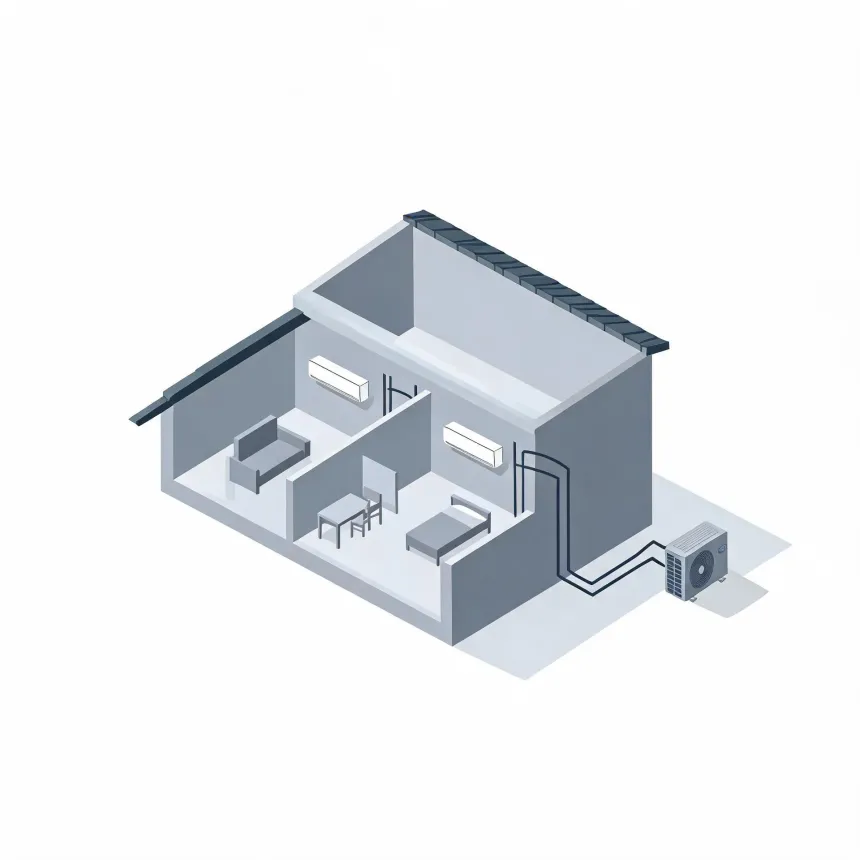
- A single outdoor unit can run one indoor head or several, depending on how it's set up. A single-zone system heats and cools one room well. A multi-zone system splits capacity across several indoor heads, each with its own thermostat, but the more zones you add, the more the total capacity gets divided among them. How many rooms make sense depends on the size of each room and how the house is laid out, which is something a contractor sizes room by room rather than guessing at.
- Can a mini split heat a whole house?
- It can, if it's sized and placed for that from the start. A multi-zone mini split with enough indoor heads can heat every room, and heat pumps keep working in cold weather, which matters here since homes need heat from September through May. The harder part in an existing house is placement, since each zone heats the room it's in and rooms without a head depend on open doors and airflow to stay warm. A contractor can size the system against your coldest nights and tell you whether whole-house coverage works for your layout or whether some rooms need their own head.