Signs of leaky ductwork in Bismarck, ND

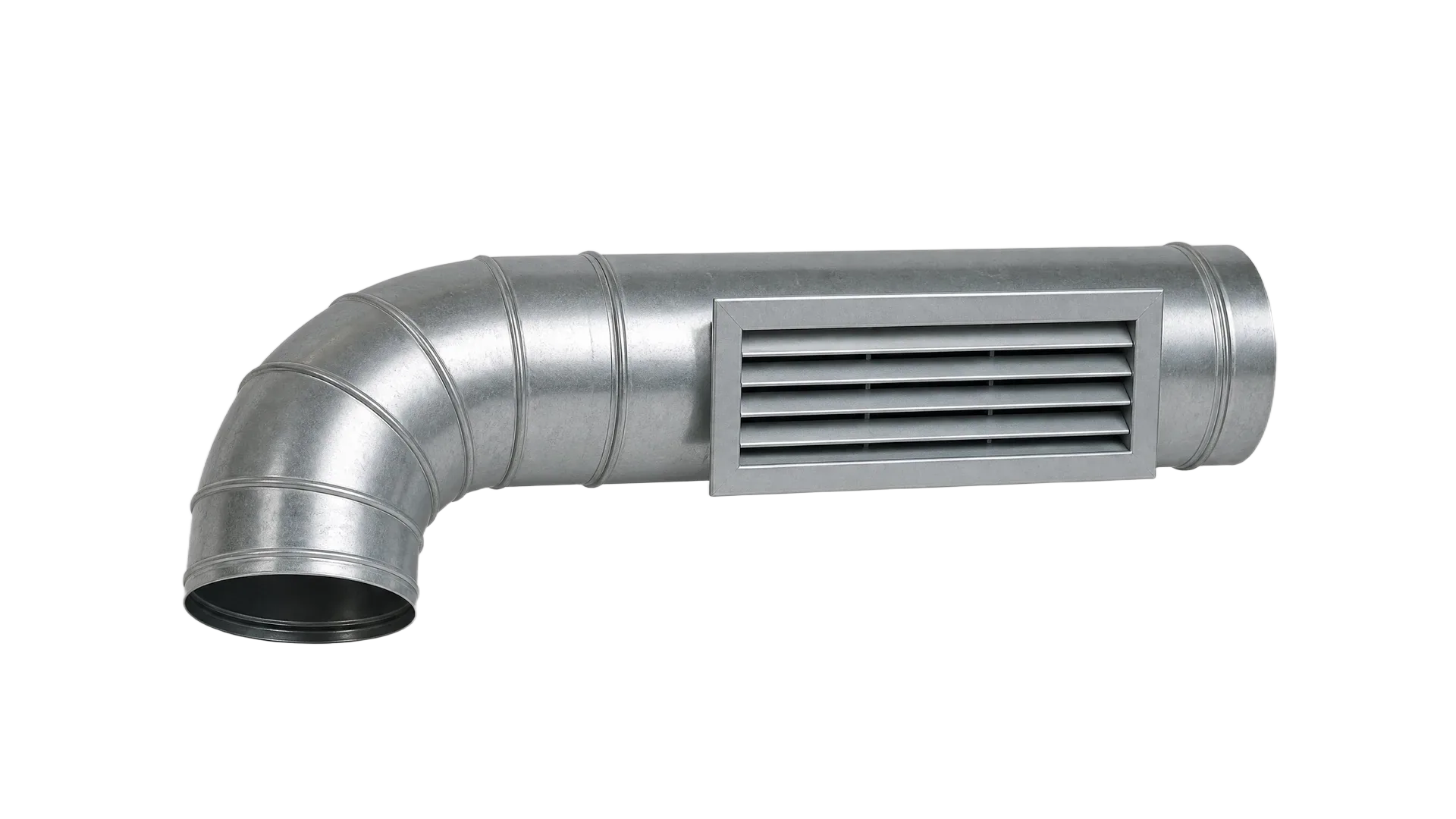
A galvanized steel round duct section with a 90-degree elbow and a rectangular louvered grille on its straight run, shown against a plain gray background.
Find a pro near me

Leaky ductwork shows up as rooms that never feel right. One bedroom stays cold all winter no matter what the thermostat says, or the room over the garage runs warm all summer while the rest of the house is fine. You might notice your gas bill climbing in January and February without a reason, or hear air moving in the attic or basement when the furnace kicks on. Dust building up fast around vents, or a vent that barely puts out any air compared to the others, points the same way. Ducts leak at the seams and the connections, where sections join or where someone cut into the line for a branch. Once a seam opens, the furnace is pushing heated air into your attic or crawlspace instead of your bedroom, so the furnace runs longer to make up for it. In a place where winters are hard and homes lean on gas heat for months, that loss adds up fast, and it is worth having the duct system checked before the cold settles in for good.

Why does duct leakage matter more in an older Bismarck-area home?

  • Half the homes here were built by 1988

    Half the homes in Burleigh County were built in 1988 or earlier. Ductwork that old has had decades for joints and seams to work loose.

  • Heat runs September through May

    Heat runs about nine months a year here, September through May. A leak in that run of duct wastes gas for most of the year.

  • Cooling runs July through August

    Cooling only runs July through August here. A duct leak costs less over a summer, but it still means an upstairs room that never cools down.

ACS 2020-2024 · NOAA nClimDiv 1991-2020

Supply duct leaking into a wall or crawlspace

A supply duct carries heated or cooled air away from the furnace toward a room. When it leaks before it gets there, that air ends up in the crawlspace or inside a wall instead of the room it was meant for. The room runs weak. The thermostat reads one temperature while the air coming out of that register barely moves. You end up running the furnace longer to get the same comfort, and the attic or crawlspace gets warmer than it should while the living space stays cold.


Return duct pulling in outside air

A return duct pulls air back to the furnace to be reheated or cooled again. If it leaks in an attic or crawlspace, it pulls in outside air instead, along with dust and whatever else is sitting in that space. That outside air has to be heated or cooled before it ever reaches a room, so the furnace works harder for the same result. You might notice more dust around vents or a house that feels drafty even with the furnace running.

A woman in a cream turtleneck sweater stands beside a multi-pane window looking out at falling snow, with a dimly lit living room containing a lamp, sofa and shelves behind her.
A woman in a beige turtleneck sweater stands by a large window with snow-covered trees outside, in a living room with a lit lamp, sofa with cushions, and a wood stove with visible flames.
A woman with long dark hair in a beige knit turtleneck sweater stands beside a window with snow outside, looking off to the side, with a warmly lit living room containing a sofa, lamps and a coffee table behind her.
A woman with shoulder-length brown hair in a beige knit sweater stands near a window looking outside at falling snow and snow-covered evergreens, with a dimly lit living room, sofa, lamp, bookshelf and framed landscape painting behind her.

How Duct Leaks Actually Form

  • A return leak pulls air from the attic or crawlspace instead of the room, so the furnace heats air it never needed to.
  • Duct tape fails within a few years on real ductwork, no matter what the name suggests, and leaves the seam open again.
  • Leaks near the furnace itself waste more air per hour than the same size gap out at a duct run, since all the air passes that point.
  • A disconnected duct at a joint dumps air straight into the crawlspace, which reads as a bigger loss than a seam that only cracked open.
  • Mastic sealant holds on metal and flex duct in a way tape does not, because it bonds to the surface instead of just sticking to it.
  • A blower door and duct pressure test can find leaks that are not visible, since plenty of leaking ductwork runs behind drywall or under insulation.

Ductwork fails in a few specific spots, and knowing which one matters because the fix is different each time. Return ducts run under negative pressure, so a gap there does not blow air out, it pulls air in. If that return runs through a crawlspace, the furnace ends up heating or cooling air that already leaked in from outside the house, which is wasted work before the air ever reaches a room. Supply-side leaks behave the opposite way, pushing conditioned air out of the duct wherever a seam has opened. Where that leak sits changes how much it costs. A gap right at the furnace or plenum carries the full volume of air moving through the system, so a small opening there loses more than the same size gap would farther down a branch line serving one room. A duct that has come apart at a joint entirely is worse still, since the full run is now open to the crawlspace or attic instead of just a cracked seam. Sealing any of this with duct tape is a short-term fix at best. The adhesive dries out and lets go within a few years, especially with the temperature swings a Bismarck attic or crawlspace sees across a winter. Mastic, a paste-like sealant brushed on by hand, bonds to metal and flex duct instead of just sticking to the surface, which is why contractors use it on the seams that matter. Finding leaks hidden behind drywall or insulation usually takes a blower door test paired with duct pressure testing, since plenty of the worst leaks never show themselves any other way.

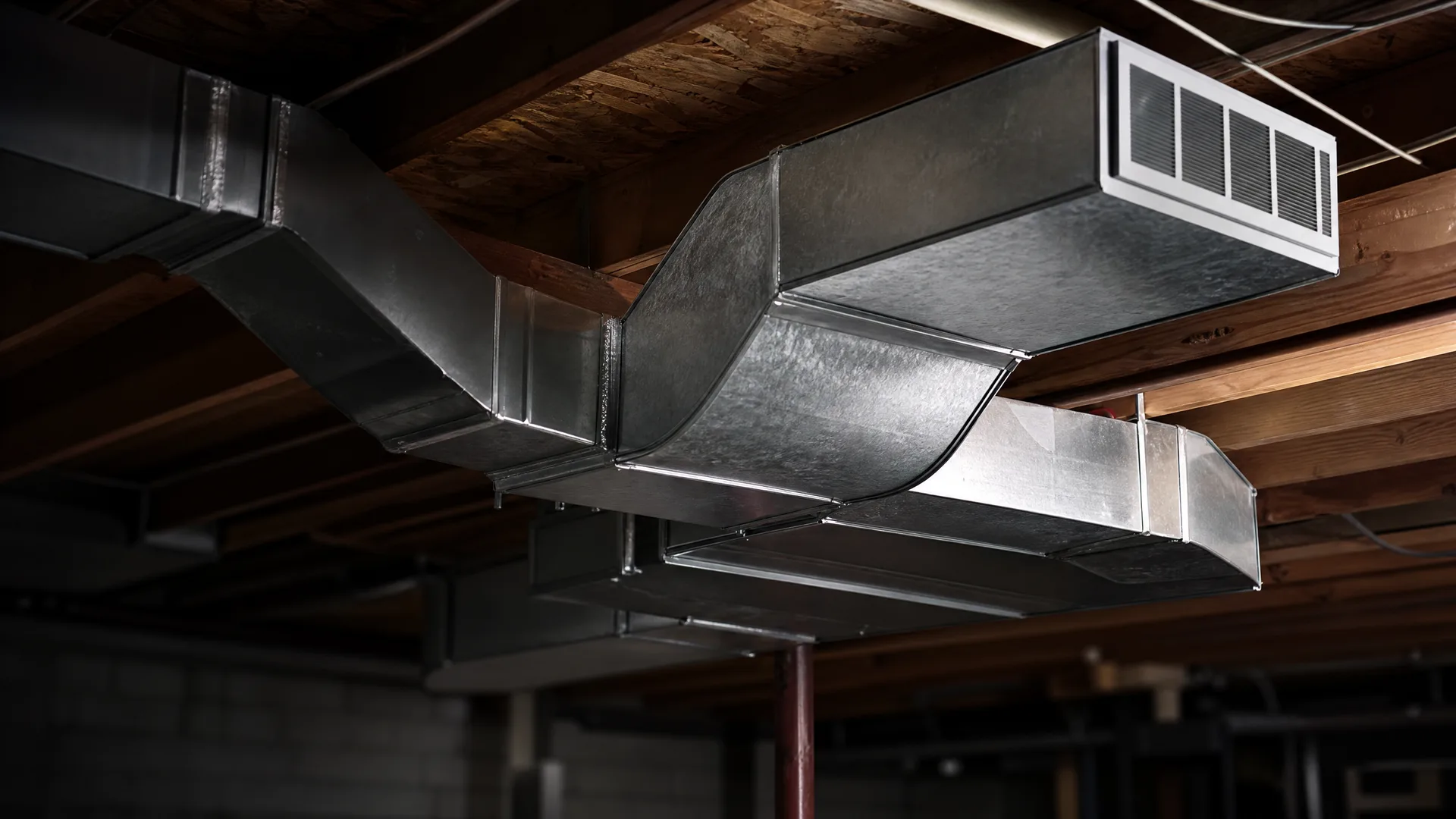
Galvanized sheet metal HVAC ductwork with a vent grille running along a wooden joist ceiling above a bare concrete wall.
Before you get your ductwork cleaning
A basement with a gray furnace on a concrete pad connected to large sheet-metal ducts running along an exposed wood joist ceiling, with PVC pipes and plastic sheeting on the walls.
After you get your ductwork cleaning

Picture the duct run from your furnace to the far bedroom. Every foot of that run is a chance for a seam to have opened, and the room at the end of it feels the loss first. In a crawlspace in January, a leak is dumping heated air into a space that might be 40 degrees, and the furnace just runs longer to cover for it. That longer cycle, with nothing else in the house changed, is usually a sign air is going somewhere other than the room it was meant for. You might see it before you feel it: a floor register or supply vent collecting dust faster than it should, which means the duct behind it is pulling in air from the attic or crawlspace instead of the room. And you'll see it on paper too, in a gas bill that jumps without a matching cold snap to explain it. None of this means the furnace is failing. It means some of what it makes never reaches you.

What a leak costs your house

  • A bedroom with a long duct run to the furnace loses more heat to a leak along the way than a room close by.
  • A crawlspace leak in January pushes heated air into a space that's maybe 40 degrees, and that furnace just keeps running to make up for it.
  • Dust around a floor register or a supply vent that never seems to stop collecting grime often means the duct behind it is pulling in attic or crawlspace air.
  • A furnace that runs longer cycles than it used to, with no other change in the house, is often pushing air that never reaches the rooms it's meant for.
  • Rooms farthest from the furnace are usually the first to feel a leak, since that's where the least air arrives even when the system is working as it should.
  • A spike in the gas bill with no matching jump in outdoor temperature points to air leaving the ducts before it gets where it's going.
A man with graying hair and a beard in a plaid flannel shirt stands indoors looking out a frosted window at snow-covered trees, with a ceramic mug on the sill.
A smiling man with short dark curly hair and stubble, wearing a navy T-shirt, sits on a beige sofa looking down toward a dark object in the foreground, with a living room, round mirror, lamp and bright window behind him.
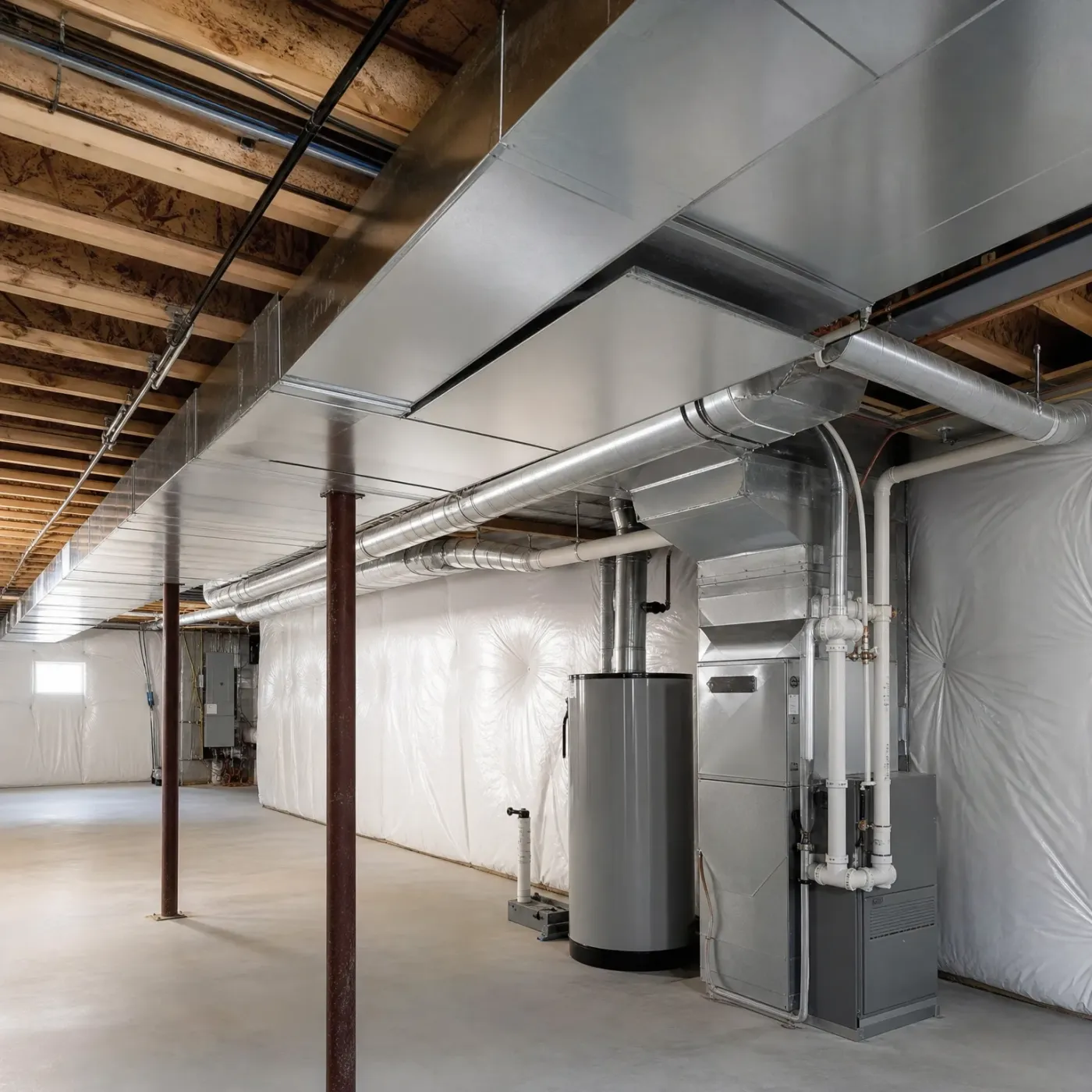
Unfinished basement with concrete floor, plastic-sheeted insulated walls, exposed wood joists, metal support posts, sheet-metal supply ducts, a cylindrical water heater and a furnace with PVC piping.

Get your ductwork to the right pro

After you send the request, you're done searching.

Get matched with someone who does this kind of work in Burleigh County.

Get my match

There's no charge for the request.

Is a leaky duct behind your dusty rooms and high bills?

A fine layer of dust that comes back days after you wipe it down is often duct leakage pulling in attic or crawlspace air instead of clean indoor air. You might hear a faint whistle near a seam when the furnace kicks on, or feel a draft near a floor register that should only blow warm air. Some homeowners notice a burnt or musty smell from ducts running through a crawlspace. Left alone through a Bismarck winter, a leak like this means the furnace runs longer to hold the same temperature, and it keeps pulling in whatever is in that crawlspace or attic, dust, insulation fibers, sometimes worse.

Unfinished basement with galvanized sheet-metal rectangular and round ductwork running along a wood-joist ceiling, two steel support columns, a small window, and a furnace unit against the far right wall.

Ductwork sealed and sound

This is what a tight system looks like from the basement. Air moves through the metal and spiral duct straight to each room, and the furnace cycles off once the house reaches temperature. No whistle near the seams, no warm air leaking out against the joists.

An unfinished basement with bare concrete walls and floor, showing exposed wooden floor joists, pipes, wiring, and metal HVAC ducts with a vent grille overhead.

Ductwork losing air

Here the same kind of run is quietly feeding the space between the joists instead of a room. Look at the plenum boxes and the seams where round duct meets rectangular. A gap at any of those joints lets heated air spill into the basement instead of reaching the vent.

Seal The Leak Or Live With It

You seal the ducts

  • A contractor can find the actual leak location with a pressure test instead of guessing from where the dust is worst.
  • Mastic sealant applied at the joints holds up over time in a way duct tape never does.
  • Your furnace stops heating air that was headed for the crawlspace instead of your living room.
  • The room that's been cold all winter has a real chance of matching the rest of the house once the leak feeding it is closed.
  • Gas use in January reflects the house you're actually heating, not the house plus a leak.

You leave it as is

  • The furnace keeps cycling longer to make up for air it's losing before it reaches the register.
  • Whatever gets pulled in through a return leak, attic dust, crawlspace air, keeps settling on your furniture and floors.
  • The cold bedroom and the warm room over the garage stay the way they've always been.
  • A small gap at a joint doesn't close itself, and the duct metal around it doesn't tighten with age.
  • Your gas bill carries the cost of the leak every month, not just the ones you happen to notice it in.
  1. Furnace pushes warm air into the supply ducts.

  2. Air pressure builds highest at joints and seams.

  3. Loose joints let air escape before it reaches the room.

  4. Lost air collects in the crawlspace, attic or wall cavity.

Unfinished basement with bare concrete walls and floor, showing exposed wood floor joists overhead with sheet-metal rectangular ductwork, insulated flexible ducts, and pipes.
Metal and flex duct run tight from joist to joist, with every seam sealed, so warm air goes where the furnace sent it.
Basement ceiling with galvanized sheet metal rectangular ducts and round pipes running between wooden joists above a bare concrete wall and floor.
Loose seams and sagging flex duct along the same joists let heated air spill into the basement instead of the rooms above.

Power here costs 11.91 cents per kilowatt-hour

At 11.91 cents per kilowatt-hour, power here is cheap, which is part of why a leaky duct system hides so well. The furnace fan and blower barely register on your bill, so the real cost of a leak shows up in gas, not electric.

EIA-861 2025

Unfinished basement with galvanized sheet-metal ductwork and pipes beneath wood joists, a gray furnace unit at left, insulated plastic-covered walls over a concrete foundation, and a bare concrete floor.

Ductwork running the way it should

This is a basement with sealed joints. Metal duct runs joist to joist to the furnace in the corner, and the poly vapor barrier on the walls keeps the space dry. Air stays inside the metal from the furnace to the room, so nothing is feeding dust or lost heat into the basement below it.

Empty concrete-walled basement room with galvanized rectangular and round HVAC ducts and pipes running along the exposed wood-joist ceiling.

Ductwork losing air along the way

Bare concrete and exposed duct make a leak easy to miss, because nothing here is sealed or finished. A seam coming apart under those joists dumps air into this room instead of the one it was meant for, and the furnace just runs longer to cover the difference.

A woman in a cream sweater and jeans stands in an open black front door of a white stucco house, viewed over the shoulder of a man in a navy jacket in the foreground.

A cold room or a high gas bill is telling you something

The signs don't change: a room that never feels right, dust that keeps coming back, a gas bill that climbs past what the weather explains. Any one of those by itself can mean something else. Together, in a Bismarck winter, they usually mean the ducts are losing air before it reaches the room.

You don't have to find the exact seam or guess whether it's a supply run or a return. That part is a pressure test and a trained eye, not a guess from the basement stairs. Once you send the form, a contractor who works on ductwork in the Bismarck area will reach out and take it from there, matched to what you've described about your house.

A gray upholstered sofa with a textured cushion sits beside a dark round side table holding a vase of green foliage, with a table lamp and sheer-curtained window behind.
Galvanized sheet metal HVAC ductwork with a white vent grille, mounted against wooden floor joists in a dim basement with concrete block walls.

Find a duct system cleaning pro in Burleigh County

Duct and vent cleaningDucts or ventsBurleigh County, ND
Step 1 of 2

What ZIP code is the job in?