








North Dakota HVAC Guide

Is a clogged dryer vent a fire risk in Bismarck, ND

Get matched with someone who does this kind of work in Burleigh County.

Get matched

Is a clogged dryer vent a fire risk in Bismarck, ND?

You run a load of laundry and notice it takes two or three cycles to dry what used to take one. Or you've just smelled something warm near the dryer, not quite burning, but enough to make you pay attention. With a hard North Dakota winter ahead and the dryer running most days, it's a fair question to stop and ask before it turns into a bigger problem.

Yes, a clogged dryer vent is a fire risk

Lint is the fuel. Every load sheds some, and what the lint trap doesn't catch moves down the vent line and settles there. A clogged vent traps heat inside the dryer instead of letting it escape outside, and that heat builds against the lint until it's enough to ignite. This holds true in any house, but it matters more here because the dryer runs harder and longer through a Bismarck winter, with cold, dry air coming in and laundry piling up during the months you're stuck inside. A vent that moves air fine in July can be mostly blocked by January without ever being touched. If drying times have crept up or the outside vent hood barely flutters when the dryer runs, the line is restricting airflow somewhere between the machine and the outside wall.

A white hooded dryer vent cover with a screened opening mounted on beige horizontal lap siding, with a blank white area filling the right side of the frame.

Why lint builds up so fast

Every load sends lint down the vent along with the hot air, and most of it moves out fine. What doesn't catch on the sides of the duct, especially where it bends or where two sections meet. A straight, short run clears itself better than a long one with turns. Many Bismarck homes have the dryer set up with at least one elbow in the line, and that's exactly where lint tends to sit and build.

A white hooded exterior vent cover with louvered grille mounted on light-colored horizontal lap siding, next to a blank wall corner.

What a blocked vent does to heat

A dryer is built to push hot, damp air out through the vent with every cycle. When lint narrows that path, the air has nowhere to go, so heat backs up into the drum and the machine itself. The igniter or heating element keeps firing because the thermostat still reads the air as cool, not knowing the real problem is a vent that can't move air anymore. That trapped heat is what collects around lint, and lint ignites easily.

What does your house tell you about your dryer vent risk?

  • 2.34 people per household on average

    The average household in Burleigh County holds 2.34 people, which means more loads through that vent every week than a single person running a load now and then.

  • Half the homes here were built by 1988

    Half the homes in Burleigh County were built in 1988 or earlier. A duct run that old has had decades to pick up dents, sagging joints, or a crushed section behind the dryer.

  • Power here costs 11.91 cents per kilowatt-hour

    Power here runs 11.91 cents per kilowatt-hour, cheap enough that most people never notice a dryer working harder than it should until the vent is cleaned.

ACS 2020-2024 · EIA-861 2025

What a clean vent looks like

A clean vent moves air fast enough that you can feel it push out at the hood from across the yard. A load of towels dries in one cycle, same as it always did. The outside of the dryer stays close to room temperature, maybe a little warm near the back. Open the lint trap after every load and there's lint on it, not behind it. No warm, stale smell builds up in the laundry room while the dryer runs. If you pulled the vent apart right now, you'd find a thin, even layer of dust at most, nothing packed in at the bends. This is the baseline. Everything else is a step away from it.

What a clogged vent looks like

A clogged vent gives you a dryer that runs hot and takes two or three cycles to do what one used to do. The hood flap barely lifts when the dryer is on, or doesn't lift at all. You smell warm lint in the air, sometimes a faint burning smell that isn't quite smoke. The dryer itself gets hot to the touch, the top or the front panel more than you remember. Clothes come out hot and slightly damp instead of warm and dry. If the vent run is long or has several bends, which is common once the dryer sits on an interior wall, these signs show up sooner and get worse faster the longer the lint sits packed against the duct.

A woman in a cream turtleneck sweater stands beside a large window with snow outside, looking to the side, in a dimly lit living room with a sofa, lamps, candles and framed artwork.
A woman in a light gray cable-knit turtleneck sweater stands by a window looking outside at snow, with a living room behind her containing a stone fireplace, lit lamp, framed pictures, and a sofa with a plaid throw.
A woman in a dark gray turtleneck sweater stands by a window with snow visible outside, in a dimly lit living room with a gray sofa, lamp, framed painting, and dark-framed glass door.
A woman in a cream turtleneck sweater stands by a window looking out at falling snow and snow-covered trees, with a dimly lit living room containing a sofa, lamp and fireplace behind her.
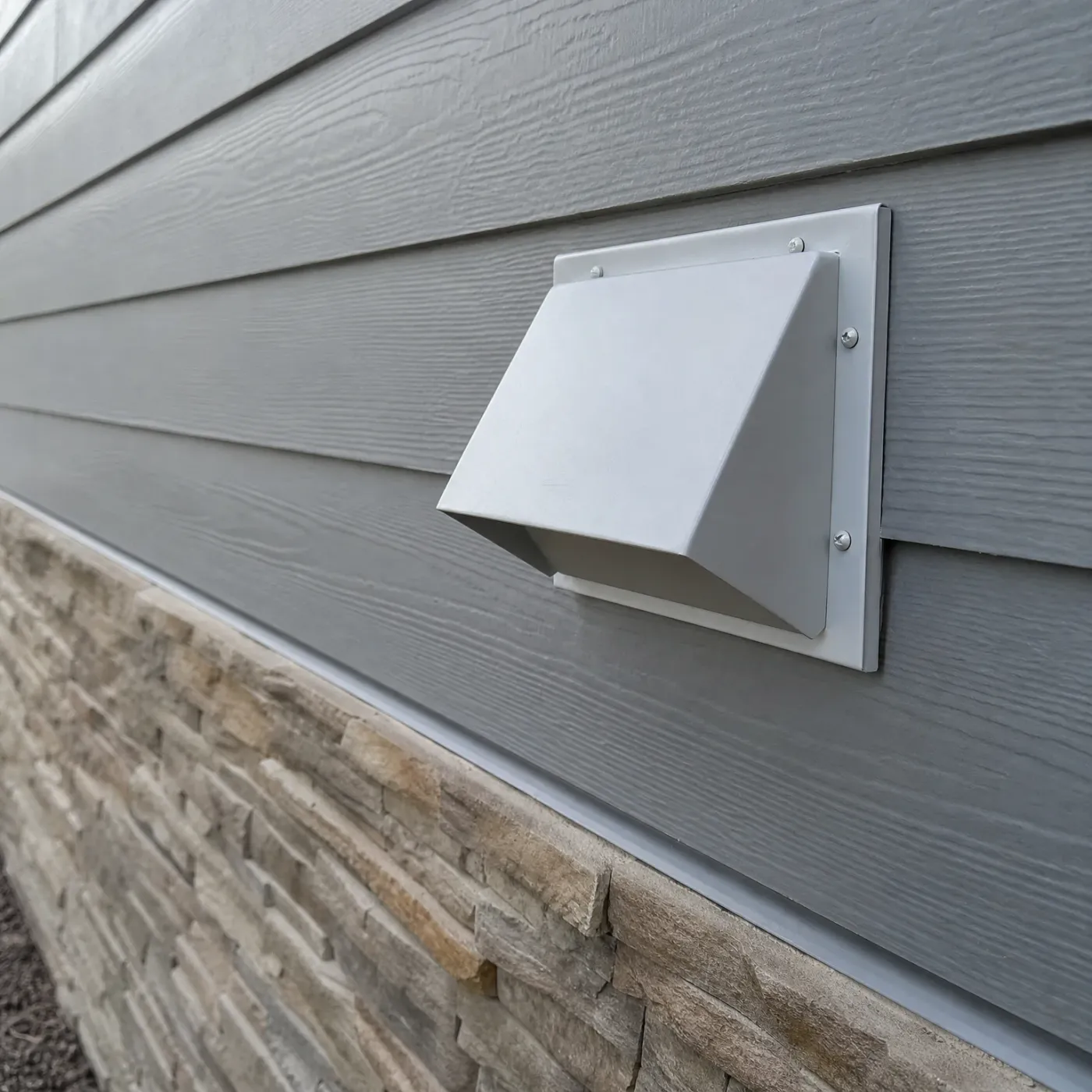
A white hooded exterior vent cover screwed to gray horizontal lap siding above a stacked stone veneer base.

The right pro for this job

Your request goes to one pro, not a list of companies.

Get matched with a Burleigh County pro who cleans dryer vents.

Reach a local pro

Sending the form costs nothing.

Clean Vent vs. Clogged Vent

Clean vent

  • Air pushes out at the hood hard enough to feel from several feet away, even in cold weather.
  • A load of towels finishes in one cycle instead of two or three.
  • The dryer runs its normal cycle length and shuts off on schedule.
  • Lint builds up slowly in the trap and the duct, not fast enough to choke airflow between cleanings.
  • The space around the dryer stays close to room temperature during a cycle.
  • Gas dryers vent their exhaust outside efficiently, so the room doesn't pick up a warm, damp smell.

Clogged vent

  • Lint packs in at the bends and the seams, where it catches instead of blowing through to the hood.
  • Drying times stretch to two or three cycles for the same load that used to take one.
  • Heat has nowhere to go, so it builds up inside the duct and around the dryer itself.
  • The outside hood flap barely lifts, or doesn't lift at all, when the dryer is running.
  • A warm, not-quite-burning smell shows up near the dryer, especially a few minutes into the cycle.
  • With more people in the house running more loads, a packed vent gets worse week over week instead of staying the same.
A white hooded dryer vent with a square screwed-on flange mounted on gray horizontal lap siding, above a concrete foundation wall edged with gravel stones.

Vented and clear

This is what a working vent looks like from outside. The flap sits closed except when the dryer runs, and air pushes it open and out past the hood. No lint ring builds up around the opening because what comes through keeps moving, out past the siding and away from the house.


A lint-clogged hooded dryer vent mounted on light gray horizontal lap siding above a concrete foundation wall.

Clogged and stuck open

Here the flap can't close because lint has packed into the hood itself. That buildup sits right at the exterior wall, close to the siding, with hot air from every load passing through it. It's the kind of blockage you can spot without a ladder, just by walking up to the wall.

A clogged dryer vent is a fire risk, and the signs show up before anything catches. Longer drying times, a dryer that runs hot to the touch, a weak push of air at the hood outside, lint collecting where it shouldn't. None of that is normal wear. It's lint building up somewhere between the dryer and the outside wall, cutting off the airflow the dryer needs to run safely. A vent that's been cleared moves air hard enough to feel from across the yard, and a load of towels goes back to finishing in one cycle. If your vent is showing any of what's described above, that's your answer, and it's worth having someone look at it before the next load rather than after. A local contractor who works on these every week can tell you in a few minutes whether what you're seeing is lint buildup or something else, and clear it if it is.

A bearded man in a red and dark plaid flannel shirt looks out a frost-edged window at a snow-covered yard, with a gray mug on the sill in the foreground.
A bearded man in a dark gray T-shirt sits smiling on a light gray couch, with a houseplant and a framed picture on the wall behind him.

Dryer Vent Cleaning

Matched to your dryer vent job

The pro who gets in touch is licensed in North Dakota and works in Burleigh County.

A black-framed smartphone standing upright against a plain light gray background, its screen filled with solid green.
Duct and vent cleaningBurleigh County, ND
Step 1 of 3

What kind of equipment?