Signs of leaky ductwork in Williston, ND

Get matched with a pro who works on ducts in Williams County.

Get matched

What are the signs of leaky ductwork in my house?

Your furnace runs most of the winter and your AC runs through the warm months, and the bill still feels high for what the house actually gets. Maybe a room never warms up like the rest, or you can hear air moving somewhere it shouldn't be. You're not sure if that's normal wear or something worth having looked at, so you want to know what to actually watch for before you call anyone.

Uneven rooms, high bills and dusty air point to leaky ducts

A room that stays colder in January or hotter in July than the rest of the house is the clearest sign. So is a bill that climbs while the house doesn't feel any different. Air escaping through a gap or a loose joint never makes it to the register, so the system runs longer to make up for what it's losing, and your furnace works harder through a Williston winter than it should. Dust settling faster than usual, or a musty smell from the vents, can mean the ducts are pulling in air from a crawlspace or attic instead of the room. A hissing or whistling sound near a duct run is worth tracing too. Any one of these on its own might mean something else, but a few together usually mean the ductwork is losing air somewhere between the furnace and the room.

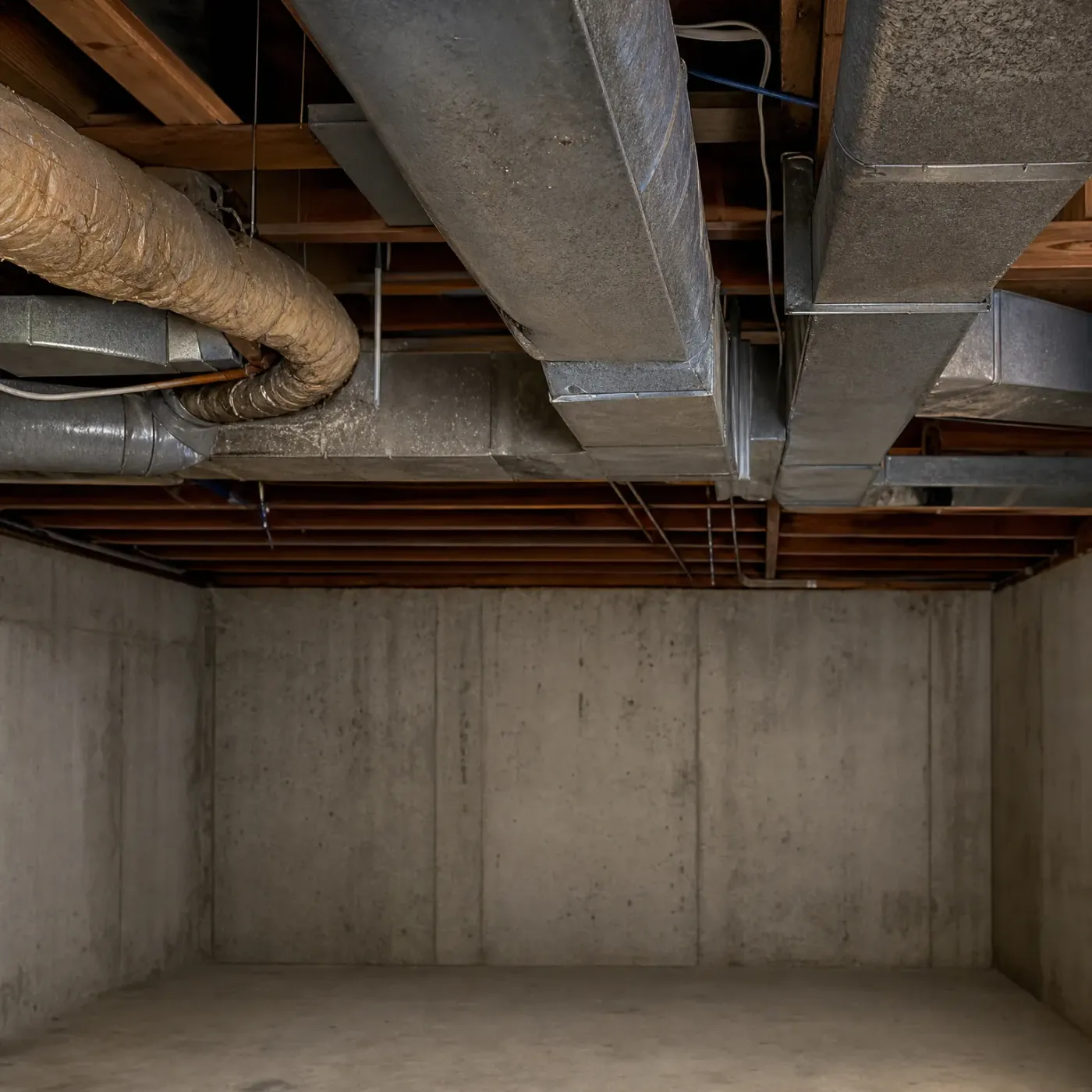
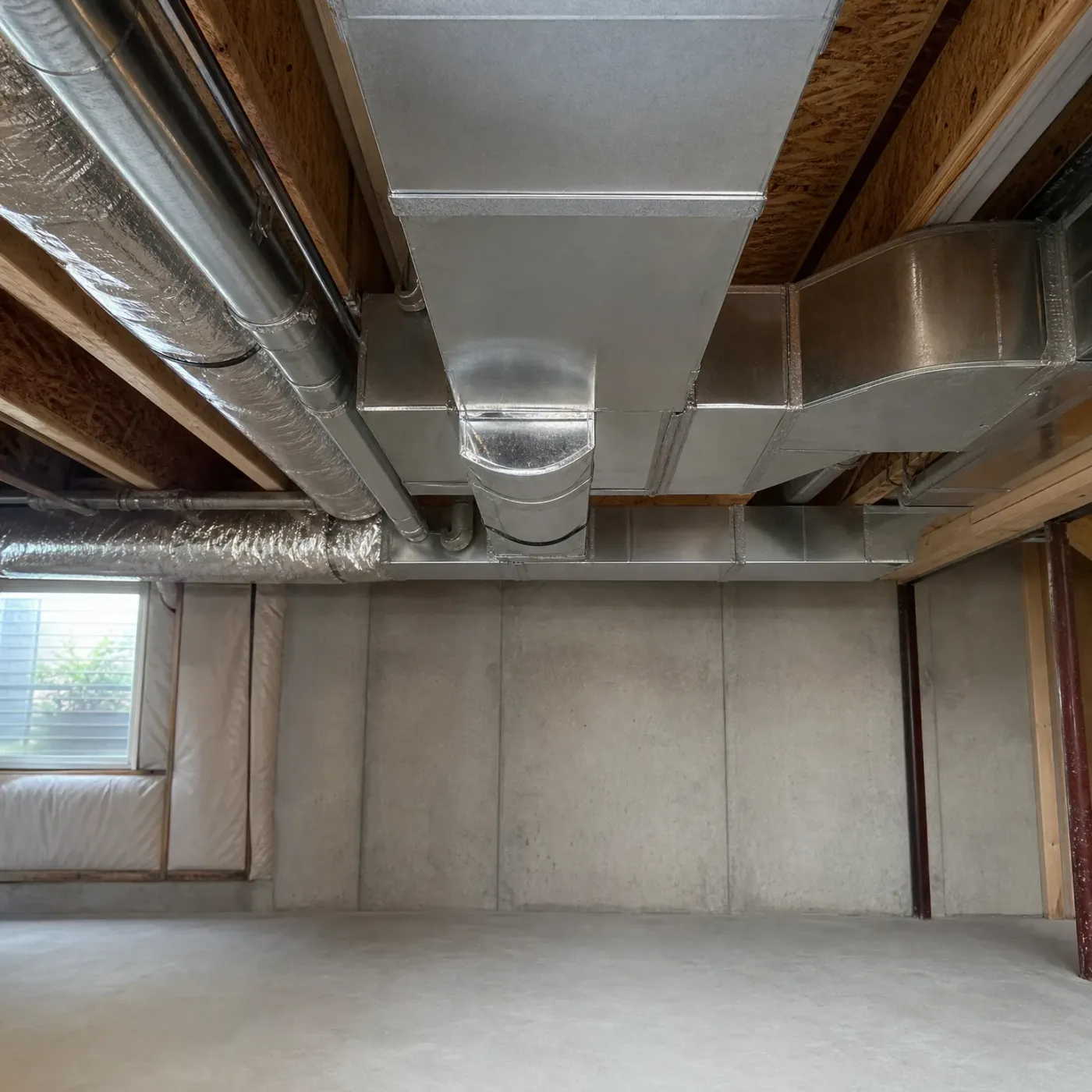
Empty unfinished basement with bare concrete walls and floor, showing galvanized sheet metal ductwork, insulated flexible duct, and pipes running along the wood-framed ceiling, with a small window at left.

Ductwork Sealed Tight

Air coming out of a vent in one room should feel about the same as any other. The metal runs and the round pipes carry air from the furnace straight to each room without losing it along the way. A system like this keeps every room close to the thermostat setting, in January and in July.

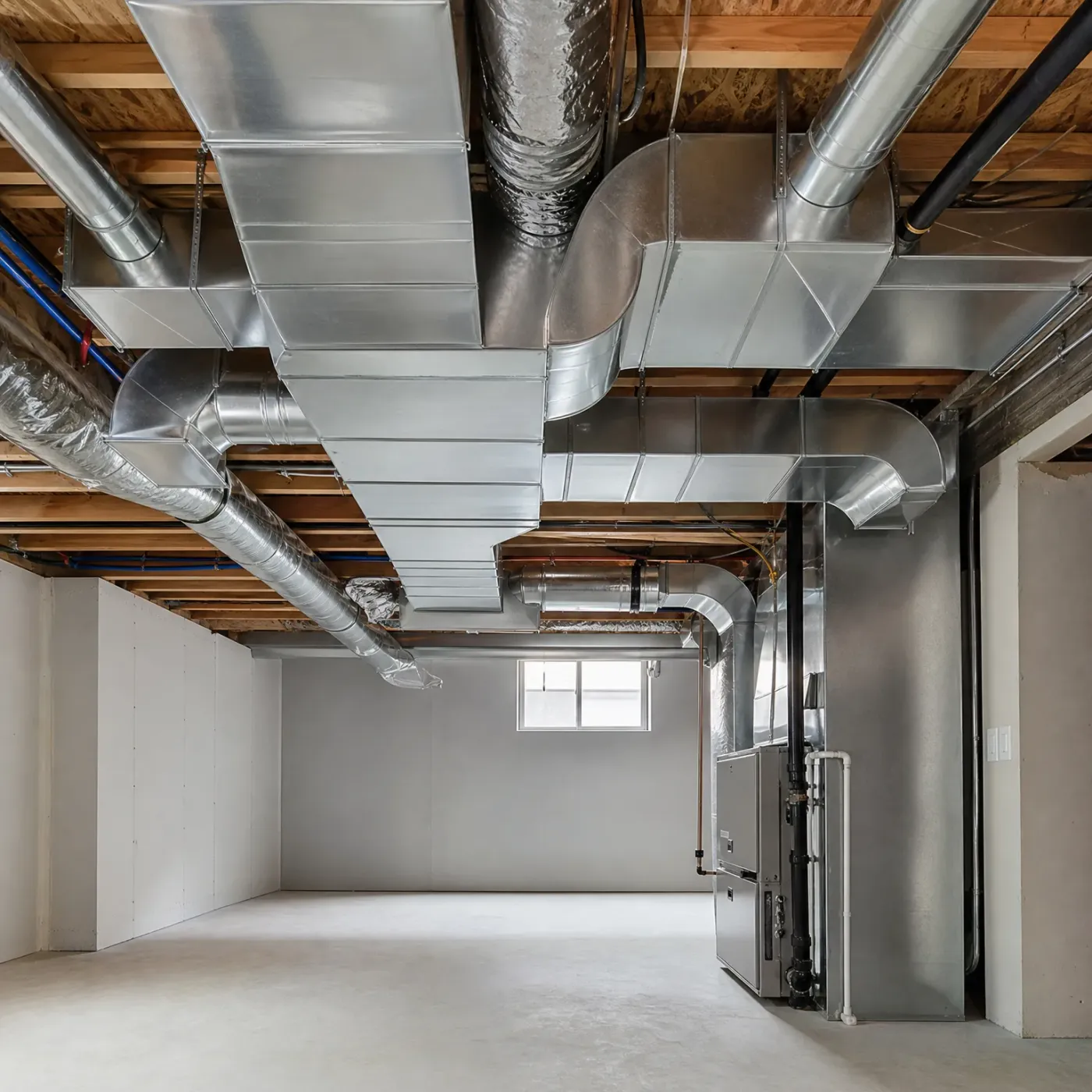
Empty basement room with bare concrete walls and floor, with exposed wooden joists, sheet-metal HVAC ducts, an insulated flexible duct, and pipes running across the ceiling.

Ductwork Losing Air

Flex duct that sags or metal joints that were never sealed let air escape into the basement before it reaches a vent. You lose heat there in the winter and cool air in the summer, and the room farthest from the furnace feels it first. That lost air is what's driving the bill up.

Why would ductwork leaks even matter in your house?

  • Half the homes here were built by 2001

    Ducts run about ten months a year here, September through June. Any leak along that run is wasting heat for most of the year, not just a few cold weeks.

  • Heat runs September through June

    Cooling only runs about two months, July and August, but a leaky duct still dumps cool air into the attic or crawlspace instead of the room you're trying to cool.

  • Cooling runs July through August

    Half the homes in Williams County were built in 2001 or earlier. If yours is one of them, the ductwork has had decades to work loose at the joints.

ACS 2020-2024 · NOAA nClimDiv 1991-2020

Where Your Ducts Actually Leak

  • Leaks usually start where two pieces of metal duct join, not along a flat run.
  • Flex duct leaks most where it clamps onto a metal collar near the furnace or a vent boot.
  • A duct leaking in an unconditioned attic or crawlspace wastes more air than the same leak in a conditioned hallway.
  • A leak on the return side pulls in dusty attic or crawlspace air and pushes it through the whole house.
  • Disconnected duct at a boot behind a wall or floor can dump air into that cavity instead of the room.
  • Mastic sealant holds up over time better than cloth tape, which dries out and peels off the metal.

Ductwork rarely fails along a straight run. It fails at the joints, the places where one section meets the next, gets screwed together and wrapped or sealed. Metal duct joints work loose as the system heats and cools and the metal expands and contracts, season after season through a Williston winter and summer. Flex duct has its own weak point: where the duct clamps onto a metal collar coming off the furnace, or where it connects to a boot at the register. That clamp can loosen over years and never get checked, since nobody looks at duct behind a wall or above a ceiling unless something seems wrong. Where the leak is matters as much as the leak itself. A gap in a hallway loses air into the house. The same size gap in an attic or crawlspace loses it outside the house completely, so that air and the money spent heating or cooling it are just gone. On the return side, a leak does something different. It does not lose air so much as pull in whatever is around it, attic dust, crawlspace air, and send that through the furnace and into every room. A boot that has come loose from the duct behind a wall or under a floor can dump air into that framing cavity instead of the room it was supposed to reach. When a contractor seals these joints, mastic is the material that holds. Cloth tape dries out and peels off the metal in a few years no matter how well it was applied.

Unfinished basement with exposed wood joists, galvanized sheet-metal ductwork, insulated flex ducts, piping, a small window, and a furnace or air handler against a gray wall.
Metal runs sealed at every joint, carrying air from the furnace to each room without losing it along the way.
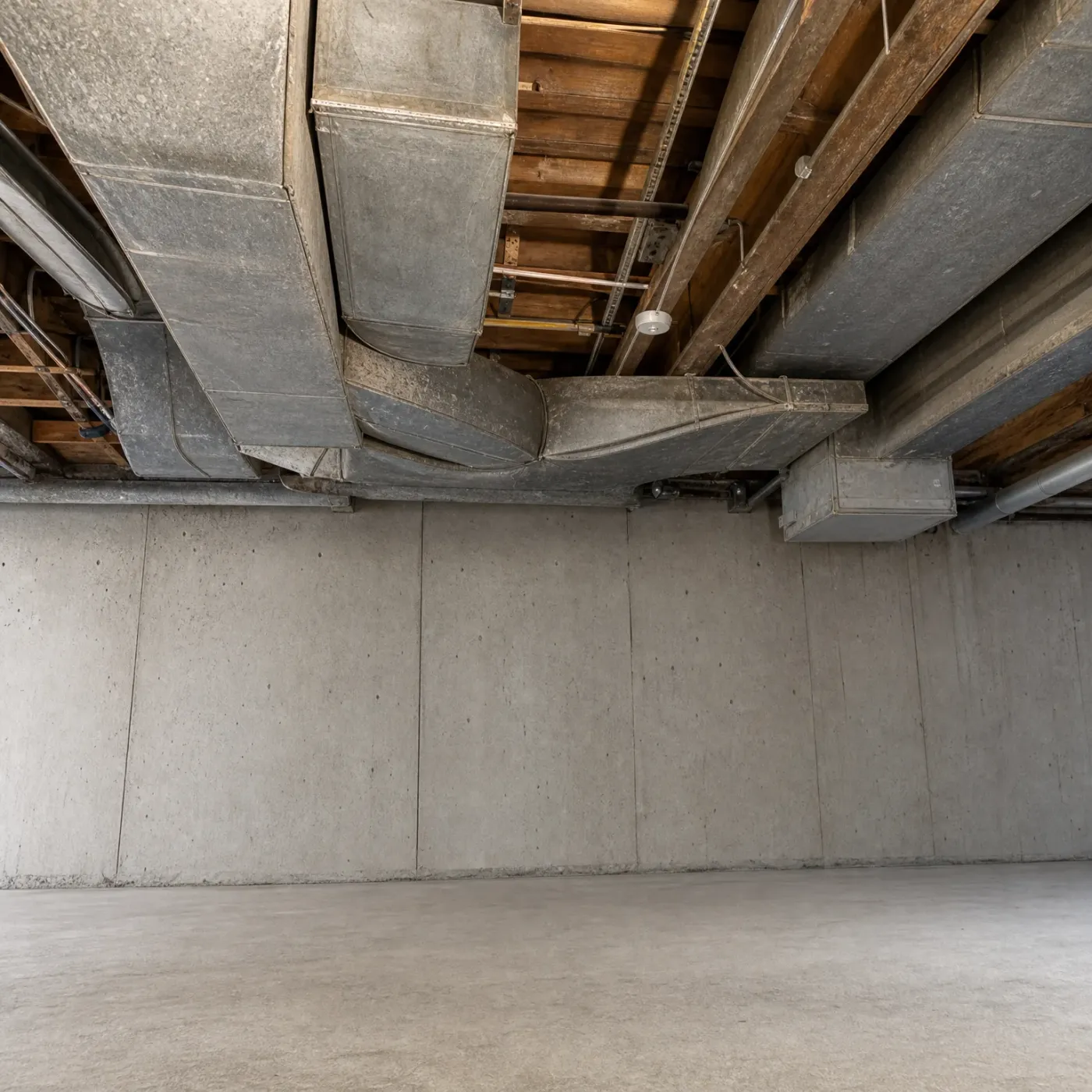
Empty basement room with bare concrete walls and floor, and an exposed ceiling of wooden joists with large galvanized sheet-metal ductwork and pipes.
A duct that was never sealed tight, running loose through the joists with nothing to stop air from escaping before it reaches a vent.
  1. Air pushes hard out of the furnace or AC plenum

  2. Pressure forces air out through loose joints and seams

  3. Lost air settles in the attic or crawlspace instead of a room

  4. Rooms farthest from the furnace lose the most pressure

Leaky Ducts vs. Sealed Ducts

Leaky Ducts

  • One room runs colder in January than the rest of the house even with the thermostat set the same for all of them.
  • You can hear a hiss or rush of air near a duct joint in the attic or crawlspace when the furnace kicks on.
  • Dust gathers fast around vent covers because the return side is pulling in attic or crawlspace air along with room air.
  • The furnace runs longer to hit the same temperature, and the gas or electric bill reflects that over a full winter.
  • Attic insulation looks darker or matted in patches where warm duct air has been leaking into it for years.
  • A door closed in one room changes the pressure enough that another room's vent barely pushes air.

Sealed Ducts

  • Every vent in the house puts out air that feels about the same, room to room, winter and summer.
  • The thermostat reading in the hallway matches what the bedroom and the living room actually feel like.
  • No hissing or rushing sound comes from the attic or crawlspace when the furnace or AC first starts up.
  • The furnace cycles off on a normal schedule instead of running long to make up for lost air.
  • Dust buildup around vents stays light since the return air isn't pulling in attic or crawlspace dust.
  • Insulation around the ductwork stays even and dry, with no warm or cool spot from air escaping nearby.
Unfinished basement with bare concrete walls and floor, and galvanized sheet-metal HVAC ducts, pipes and wiring running along the wood-joist ceiling.
Before you get your ductwork cleaning
Unfinished basement with concrete walls and floor, a steel beam on posts, and exposed wooden joists with sheet-metal ductwork and piping overhead.
After you get your ductwork cleaning
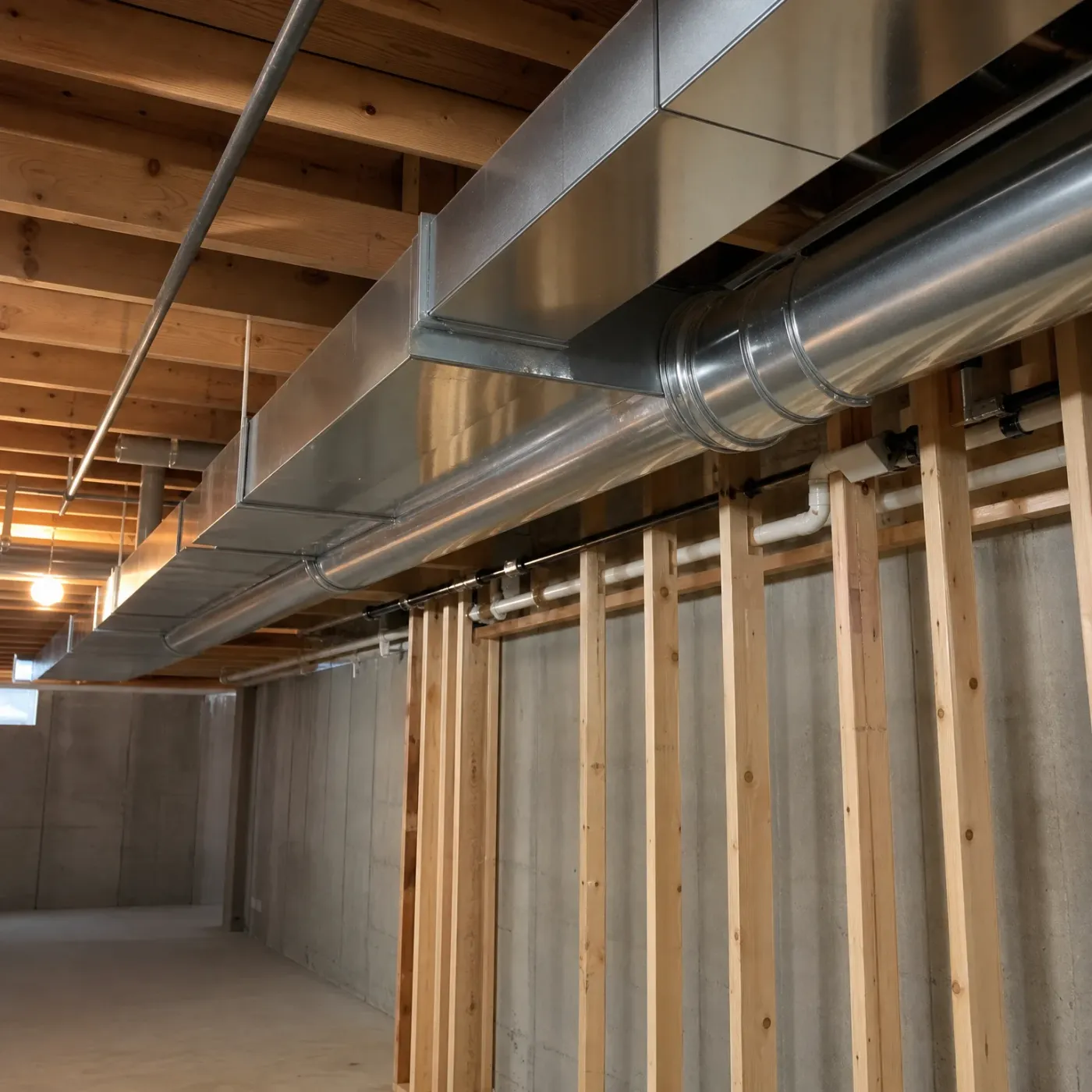
Unfinished basement with exposed wood joists, galvanized rectangular and round ductwork, piping, stud framing against concrete walls, and a bare hanging light bulb.

Get matched with a duct system pro in Williams County

Skip searching for someone who cleans ducts in Williams County.

Your request goes to a Williams County pro who takes ductwork jobs.

Fill out one form

Asking costs nothing, and the choice to hire stays yours.

Why does one room never feel right?

Walk the house in January and check each vent with your hand. A duct losing air along the way means less of it reaches the far bedroom or the room over the garage, so that room stays a few degrees off no matter where the thermostat is set. You might notice a faint burning or musty smell when the furnace first kicks on, air pulled from the attic or crawlspace instead of clean supply air. A film of dust settling faster near certain vents is another sign, dust pulled in through the same gaps the warm air escapes from. Left alone, the furnace runs longer to make up the difference, and the house never quite catches up to what the thermostat says it should.

A dimly lit living room corner with a gray wall, framed picture, a table lamp on a wooden side table, a beige sofa with pillows, a ceiling vent, and windows showing flowering trees outside.

Mid-April, late morning, sun coming in flat across the living room floor. You're up on a chair to swap out a lightbulb and you notice the ceiling vent grille a foot from your head is gray with dust, thick enough to see the pattern of the grille going soft at the edges. You look down. The bookshelf under it has the same gray film, and so does the top of the TV. You run a finger across the shelf and it comes back dark. The furnace hasn't run in days with the weather this mild, but the dust kept showing up anyway, pulled through somewhere between the duct and the room, settling on everything under the vent long after the air stopped moving.

Power here costs 9.62 cents per kilowatt-hour

At 9.62 cents a kilowatt-hour, power here is cheap, which is exactly why a leaky duct run hurts more on the gas side. Your furnace works through a hard winter to make up for air lost before it reaches the vent, and that's the bill you feel.

EIA-861 2025

Living with a leaky system

You keep the thermostat where you like it and the furnace runs most nights from September through June to get there. The far bedroom still needs a space heater some mornings. You've stopped asking why, and started just closing that door more. The vents get dusted every week or two because they need it again that fast. None of this is a crisis on its own, so it's easy to live around rather than look into. That's what a leaky duct run looks like day to day. Nothing breaks. The house just costs more to run than it should, and a couple of rooms never quite keep up with the rest.

Finding out what you have

A contractor can pressure test the duct system and find where it's losing air, whether that's a loose joint near the furnace, a flex run in the attic, or a boot that was never sealed to the floor. You don't have to climb into the attic yourself or guess which room's complaint means something. You also don't have to call around Williston and Williams County asking who does duct work, explain the dusty vents and the cold bedroom to three different companies, and sort through quotes that each describe the job differently. Converting here gets you matched with a contractor who handles this, and they reach out to you directly to look at what your house actually has.

An older man with gray hair and a beard stands in a dimly lit entryway wearing a dark hooded coat dusted with snow, with a lit table lamp, framed picture, and front door with glass panels behind him.
An older man with gray hair and a beard, wearing a dark snow-dusted jacket and scarf, stands smiling in a dimly lit entry hall with a lamp, wooden front door and staircase behind him.
A gray-haired bearded man in a dark coat with snow flecks on the shoulders stands just inside a dimly lit home entryway, with a lamp, framed pictures, sofa and candle-style lights in the background.
An older man with gray hair and a beard, wearing a dark coat and scarf dusted with snow, stands in a warmly lit home entryway with an arched doorway, lamps, and a living room visible behind him.

A leaky duct system shows itself the same way in almost every Williston house: one room that never matches the rest, a hiss near a joint in the attic or crawlspace, dust piling up fast around a vent, a furnace that runs most of the winter without ever quite catching up. Any one of these is worth a look. A few of them together usually means air is escaping somewhere between the furnace and the vent, not making it to the room at all. The duct run itself, sealed tight or not, is what decides whether the heat you're paying for in January actually reaches the far bedroom, or settles in the attic instead. You don't need to find the exact joint or seam to know something is off. You just need to notice the room that's never right, and stop assuming it's the thermostat.

A woman with dark shoulder-length hair sits wrapped in a gray fleece blanket on a sofa with an open book on her lap, beside a lit lamp and a dark window.
A woman in a cream knit sweater sits in an armchair indoors, eyes closed and smiling, beside a window showing yellow and orange autumn foliage, with a mug on a wooden side table and shelves holding vases behind her.

Ductwork Cleaning

Find a duct system cleaning pro in Williams County

Skip searching for a duct system pro and answer a few questions instead.

A black smartphone standing upright against a plain light gray background, its screen filled with solid green.
Duct and vent cleaningDucts or ventsWilliams County, ND
Step 1 of 2

What ZIP code is the job in?